




Lakeside Oral Surgery & Implant Solutions
CORONOIDOTOMY VERSUS CORONOIDECTOMY
The “coronoid process of the mandible” is a vertical prominence at the back end of the lower jaw just in front of the jaw joints on both sides. It develops as an attachment for the temporalis muscle which is one of the main paired closing and clenching muscles of the jaw. It is also the main muscle that we see involved in jaw muscle dysfunction, also known as TMD and TMJ.
Coronoidotomy is a procedure where the base attachment to the muscle is cut, but the bone piece is left in place. Coronoidectomy is a procedure where the bone attachment is cut and removed (J Oral Maxillofac Surg 75:1263-1273, 2017). That is a more involved procedure, but is generally felt to be a “better” “more complete” procedure. Because the coronoidectomy is more complicated and more expensive the insurers are more likely to push for the less expensive coronoidotomy. I am willing to discuss the options on a case by case basis, but by-and-large the coronoidectomy is a much better, long-term stable result, definitive procedure. Especially if my patient is a younger, active person who has already dealt with complex, long-standing concerns. If the procedure is needed, let’s do it comprehensively.
Of course every patient has their individual wants, needs, and desires. As a surgeon you present the information and options and try to tailor a procedure that will best serve their needs.
SHOULD I HAVE A CORONECTOMY FOR MY WISDOM TOOTH?
There have been a number of articles in the literature (particularly in the European circles) proposing that a procedure called a Coronectomy (removal of the tooth crown) be performed for lower wisdom teeth (third molar teeth) where the root structure is in close proximity to the neurovascular bundle. The nerve structure in the lower jaw provides feeling to the area of the lower lip, chin, lower front teeth, and gums. The idea is that you remove the crown and then let the roots erupt more to remove at a second procedure where the risk may be less. I have very strong feelings about this subject with general opposition. I will premise my comments with a qualifier that we have been performing surgical removal of third molar teeth in our practice with over 30 years experience. We treat the most difficult cases and our incidence of nerve injury of any kind is a fraction of one percent – very low. We attribute that to proper training, experience, care in treatment, skill in treatment, and appropriate preparation – imaging, etc.
- My first comment is my feeling that this treatment has been suggested to create extra surgical procedures and extra billing. Under managed care systems and government healthcare systems this can be a way to justify several procedures over time rather than one procedure.
- Second, any experienced oral surgeon can see that this procedure – leaving tooth structure (roots) in place – creates a number of variables and new risks at the surgical site and adjacent teeth and structures. Several excellent examples are that residual tooth structure typically causes quite a bit of discomfort; and also the residual tooth structure represents an ongoing risk of infection at the site and possibly affecting the adjacent tooth.
- Third, with cone beam scanning technology we are now able to visualize the tooth roots and nerve position before surgery in 3 dimensional space and help to further reduce the risk with surgical awareness of these relationships.
- Lastly, I feel that the best treatment for all but the most extreme cases is to face the risk with best information and have the impacted teeth removed.
Make sure you have a board certified oral and maxillofacial surgeon providing your care. Meet them and make sure they are caring and concerned and that they appropriately address your risk concerns. Ask for a cone beam scan to best visualize these risk concerns and do the treatment as early as possible, age 15 in my view is an ideal time where these risks are very low. The risks just increase as we age.
I have other information on my website about wisdom teeth and our philosophy toward wisdom teeth. This includes information about the white paper on third molar extractions which was published in combination with the ADA and AAOMS.
THE USE OF THE SUPPLEMENT RESVERATROL TO HELP WITH BONE HEALING
Resveratrol is part of a group of compounds called polyphenols. They are used as supplements. They are thought to act like antioxidants, protecting the body against damage that can put you at higher risk for things like cancer and heart disease. It is in the skin of red grapes, but you can also find it in peanuts and berries. It is sold in the United States as a supplement in the form of capsules. These contain extracts from the Asian plant called Polygonum cuspidatum. Other Resveratrol supplements are made from red wine or red grape extracts. There are many ads on the internet that promise everything from weight loss to a healthier, longer life.
A recent article in the Journal of Oral and Maxillofacial Surgery by Turkish authors showed that Resveratrol given intraperitoneally in rats caused a significant improvement in bone healing in tooth extraction sockets. (J Oral Maxillofac Surg 76:1404-1413, 2018). This is a very interesting article in that they conclude that “this natural compound is useful for alveolar socket healing after tooth extraction”.
There are a number of variables that come into play here: What Resveratrol compound and source are used? How well is it absorbed as the oral form in the human gut? Is it effective for humans at all? Etc. Another important positive point is that there are no reports of severe side effects of the compound, even at higher doses – so if you are inclined to want to experiment with it, it is “probably” safe.
We are always looking for methods to improve healing after bone grafting procedures and bone-healing procedures such as osteotomies and fracture treatment. I do find that a well-balanced diet is necessary for good healing. The worst healing problems that I have seen with bone grafting has been with patients who have malabsorption syndromes or who have significantly modified diets such as vegetarians. Conversely, I see the best healing with patients who eat a well-rounded, balanced diet. I do feel that supplements make a difference as I feel we see better healing in those who are on a broad balanced multivitamin regimen, but I cannot quantify or qualify that. There are just too many variables among individuals.
With this new information, I certainly would not discourage my patients from taking Resveratrol for improved bone healing – I am just not convinced yet that it can make a difference or that it is worth the expense and possible risks.
WHO SHOULD PLACE DENTAL IMPLANTS
Dental implants are not a commodity, but rather a surgically placed medical device. Materials and methods matter significantly. The skill of the surgeon matters significantly. Dental implants have an exceptionally high survival rate, but survival does not mean excellence or even adequacy. We regularly see dental implants which were placed poorly by other providers where the implant teeth are in various stages of failure and have to be removed.
Discount dental implants are just that. You get what you pay for in materials and methods. So what does that mean? Expect a well done implant to last a lifetime. Expect a budget implant to last a matter of years. There is another down side to this. As disease progresses – such as bone loss on a poorly done implant – you are losing valuable jaw bone and support needed for good health of the mouth.
The bottom line is, research out your dental implant surgeon. Look with skepticism at “one stop shops” or promises of discount treatment. We are experienced and provide excellent care. When you come to us for dental implant care it will be the best care possible.
Everything You Need to Know About Dental Bone Grafting

What exactly is a bone graft? Bone grafting is a surgical procedure done when you need to repair bone fractures or replace bone loss. When a tooth is missing or retracted from the alveolar bones that support your roots, gums and teeth, it eventually evaporates, causing facial features to shift and sag over time. This then creates potential problems such as pain in your mouth, not being able to speak properly, or chew food adequately. Fortunately, with the help of bone grafts, the bone that has been lost can be built again, which will not only heighten your appearance by providing strength back into your jaw bone, but also allows us to place a dental implant (artificial tooth) on top of it! In simple terms, the goal of bone grafting is to provide a safe, long-term solution to tooth loss!
How it works: The procedure itself is done by using a piece of bone (typically from your own jawbone; however artificial is also an option) as the base for your implant. Depending on the type on dental implant you plan on the receiving, and the condition of your jawbone, the process of recovery can take up to several months for the transplanted bone to grow enough to fully support the implant. Once the jawbone is healed, titanium, screw-like posts act as the new implant’s roots for fully functioning tooth support. The final step of dental bone grafting is to make molds of your teeth and jawbone, which will then follow with the placement of your realistic-looking artificial tooth!
After The Procedure: Bone grafting is a very popular and safe procedure, with over two million surgeries being reported each year. Of course with any surgery, come a few risks. Common ones include infection at the source, damage to the surrounding teeth or blood vessels, nerve damage, and sinus problems. The post-procedure discomforts include swelling of the gums, brushing on the skin, and minor bleeding. Any discomfort after the procedure should only last a few days and can be managed with anti-inflammatory medication, as well as ice therapy.
Following a successful bone grafting and implant surgery, it is recommended to practice excellent oral hygiene and see your dentist regularly to ensure proper functioning of your implant! To learn more about bone grafting or think you are a qualified candidate to have it done, give us a call at Racine Office Phone Number 262-634-4646!
BLEEDING FREQUENCY OF PATIENTS TAKING TICAGRELOR, ASPIRIN, CLOPIDOGREL, AND DUAL ANTIPLATELET THERAPY AFTER TOOTH EXTRACTION
For the most part, patients who are on anticoagulation regimens can modify their treatment prior to minor elective surgery to reduce the frequency of bleeding problems during the post-treatment healing period (JADA 149(2) February 2018, Pgs. 132-138). In cases where the patient cannot be off of their anticoagulant medications, there are techniques to help to reduce the bleeding risks – such as electrocautery, primary wound closure, and use of clot stabilizing medications or bioactive materials such as PRGF in the sites – which reduce these concerns significantly.
There are still cases that require more specialized techniques. We can predict these in some cases by looking at the bleeding indices, but there are often unseen and even obscure issues which contribute to ongoing bleeding problems. Often unseen problems with the quality (qualitative) of the coagulation factors and coagulation mechanisms. Patients with these concerns often have general health and nutrition problems which give an additional onlay of risks with poor healing capacity.
The bottom line is to be sure to be looking at the whole patient and address as many of the issues as possible to give the best chance for an uncomplicated outcome.
THIRD MOLAR COMPLICATIONS IN THE ELDERLY
We treat patients of all ages for removal of teeth including impacted third molars (wisdom teeth). Changes occur with the teeth and jaw bone as we age which can affect the risk factors with this surgical care. There are a number of identifiable factors such as the relationship of the tooth roots to adjacent vital structures such as the sinuses and nerve/neurovascular bundles. (J Oral Maxillofac Surg 75:680-686, 2017). My personal experience has been that most individuals continue to have low risks with this procedure through life. At least we are able to provide extraction services safely and we are able to minimize risks with proper imaging and techniques. We can quantify and qualify the risks at the time of assessment. We can also gauge whether it is likely that the impaction may cause a problem in your lifetime or not. As a general rule, we favor early removal of wisdom teeth. This includes that it is better to remove at age 15 than age 25; 40 rather than 50; 88 rather than 98; etc. General health, medical concerns, healing capacity, comorbidities (other problems that may contribute to risk), etc. all tend to be a greater concern as we age.
If you have your wisdom teeth and are aware of potential concerns please get in and get evaluated. It makes it a lot easier and less risky.
Holiday Food Guide For After Your Wisdom Teeth Surgery
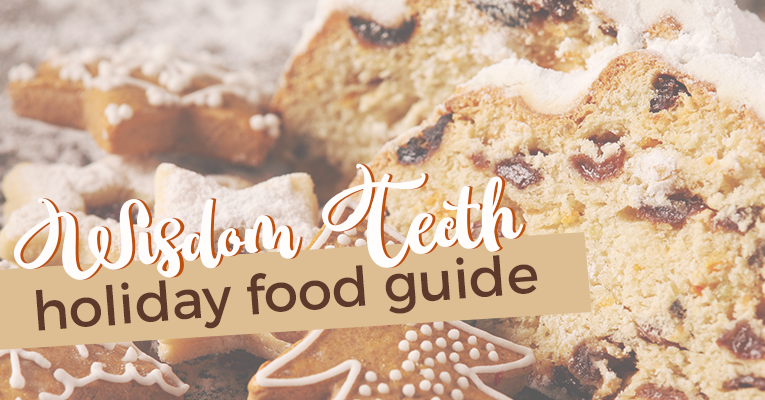
Having your wisdom teeth removed during the holidays might be upsetting— especially when thinking about all the food you’re going to miss out on. Luckily for you, there’s still hope! Fortunately, there are plenty of options that are not only delicious, but post-removal friendly!
Below is a handy post-wisdom teeth removal food guide to help you through the holiday season!
Blended soups: With the colder weather, hearty soups can not only be filling, but also easy to eat post wisdom teeth removal. Blended soups made of pumpkin or tomato will give you that festive feeling you’re looking for, while also fueling your body with vitamins like A, C and E! This will give you the nutrition your body needs, that solid foods can normally supply. Just be sure that the soups are easy to eat and don’t contain bits that could irritate or infect the area of surgery!
Salmon: Salmon is an excellent choice after your wisdom teeth removal because it’s soft and easy to chew texture. This makes an excellent main dish as it’s a great source of protein! Also rich in omega-fatty acids, Salmon may even help in the healing process by reducing inflammation!
Mashed potatoes: A holiday dinner staple! Mashed potatoes are not only a great and festive comfort food, but they’re rich in calories and will give you the energy you need while you are recovering. The great things about potatoes is that they can be prepared in a variety of different ways, are easy to eat and post-surgery friendly!
Hummus: Hummus is an excellent source of healthy fats and makes a perfect soft side dish that has plenty of protein. Plus, it’s so tasty!
Soft desserts: What are the holidays without lots of desserts? There are plenty of post-removal friendly desserts that will be sure to still give you a warm and fuzzy feeling! Puddings are a delightful treat, as the soft texture is easy to eat and won’t irritate wounds. Soft cakes and pies are fine too, just make sure to avoid the hard crust!
Even if you are planning on getting your wisdom teeth removed, don’t let it get in the way of having a wonderful holiday season this year! If you have any other questions about what foods to eat after your procedure, or want to schedule an appointment, feel free to call our office Racine Office Phone Number 262-634-4646!
What Exactly is a Dental Implant?

Missing teeth? No problem. A dental implant is a way to replace an empty void that may be leaving you self-conscious about your smile. Whether the vacant spot is due to a sports injury, facial trauma, periodontal complication, or bad oral hygiene, it can fill the vacancy permanently and give you a boost of confidence. So, what exactly is a dental implant? Here are a few things you need to know:
• Dental implants act as a replacement for the roots of a tooth. Metaphorically speaking, they can be the anchor for crowns, bridges and dentures and are screwed into the jaw bone to provide support for replacement teeth. They are surgically inserted into the jawbone beneath the gum line.
• Dental implants resemble the shape of screws and once placed into the jawbone, will naturally bond with your natural bone to provide a strong base for artificial teeth.
• Dental implant surgery is one of the safest procedures done in dentistry.
• Dental implants will be the next best thing you’ll have to healthy and natural teeth.
• A dental implant is dependent on the oral health of the person undergoing treatment. There needs to be healthy tissue in the mouth and enough jaw bone to support these dental implants.
• After undergoing a dental implant procedure, keeping the structures healthy and clean should be done precisely and with attention to detail. This will help to maintain and ensure the long-term success of the treatment and the oral health of your mouth.
Don’t let a missing tooth or teeth stop you from living a full life without limits. Laugh and smile, indulge in foods without restriction, and most importantly, feel comfortable in your own skin. Call our office Racine Office Phone Number 262-634-4646 to find out how a dental implant can be beneficial to you and the overall health of your teeth. What have you got to lose? Call us today!
Do You Need Your Wisdom Teeth Removed?
Getting your wisdom teeth removed seems to be a rite of passage these days. Everyone knows a friend or a family member who has gotten them extracted or even have had them pulled themselves. Aside from enjoying the perks of getting these last set of molars extracted such as getting to miss school or even work for a few days, or the endless and guiltless ice cream soiree, here are the occasional and sometimes painful telltale signs that you need your wisdom teeth removed:
• Gum pain: When your “third molars” or wisdom teeth begin to erupt, they push past the gums creating an uncomfortable and hot feeling. It will most likely be accompanied with pressure or a dull throbbing sensation in the gums nearest the jaw bone. Infection can also lead to puffy and swollen gums and some unwanted drainage.
• Jaw pain: A wisdom tooth infection can cause sore throats and swollen lymph glands under the jaw. These symptoms can make the area around your jaw uncomfortable and difficulty chewing and eating may become persistent. In the case where an impacted wisdom tooth is present, it can lead to jaw aches and ear pain as well.
• Teeth and mouth pain: When you have an impacted wisdom tooth that is growing in at an angle, it can impact surrounding teeth. This can result in an increase of pressure on tooth nerves and bone, crowding the surrounding teeth. Symptoms include swelling, tenderness and pain.
You may be the lucky few who never experience these symptoms and may not even need your wisdom teeth removed if they are growing properly positioned, but making sure to address the pain and getting them removed early will ensure that you get to enjoy the perks of wisdom teeth extraction without the pain! Call our office today! Racine Office Phone Number 262-634-4646