
Lakeside Oral Surgery & Implant Solutions
The Dos and Don’ts of Good Dental Hygiene

Dental Hygiene is important. Those who practice good oral habits reap the benefits, while the latter… not so much. Most of us have a great deal of control over whether or not we keep our teeth as we age. Those who don’t follow a proper routine, end up losing their teeth, thus requiring the need of tooth replacement (such as dentures, dental implants, etc.). If you want to achieve an optimal level of oral hygiene, all you have to do is follow these do’s and don’ts!
Do…
• Brush your teeth twice a day! Use a soft-bristled brush with a fluoride tooth paste and be sure to brush all surfaces of the teeth, even the hard to reach places.
• Floss your teeth every day! Floss removes food trapped between your teeth and the film of bacteria that forms before it turns into plaque.
• Visit your dentist every 6 months! Regular visits allow your dentist to discover early signs of cavities and gum disease.
• Eat a mouth healthy diet! Indulge yourself in foods such as whole grains, fruits, vegetables, lean meats and of course, water!
Don’t…
• Forget to replace your toothbrush! Tooth brushes should be replaced every 3 month—or after you recover from being sick. If you have an electric toothbrush, replace the head rather than purchasing a whole new one.
• Brush too soon after eating! Brushing immediately after eating acidic food can cause tiny particles of enamel to be brushed away. To be safe, wait at least 1 hour.
• Go overboard with bleaching! Over-bleaching your teeth can make them very sensitive to hot and cold foods, thus causing a variety of other problems.
• Ignore pain or abnormalities! Toothaches can be a sign of a more serious dental issue. See your dentist as soon as you discover changes in your dental health.
• Consume lots of soft drinks and sugary foods! These foods are highly acidic, which wears away your enamel overtime. Frequent consumption of sugary substances allow plaque to grow more rapidly—thus the likelihood of cavities will increase substantially.
When it comes to your dental hygiene—you have the option between keeping your teeth or not. By starting to practice these dental do’s and don’ts, you will be on the right track to a long-lasting smile. Give us a call today Racine Office Phone Number 262-634-4646!
Raise Oral Cancer Awareness

April is National Facial Protection Month





Oral Surgeons Address the Opioid Crisis
Recently opioid abuse and addiction have been a hot story in the news. Dentists were made an early scape goat for prescribing problems with opioids. The truth is that Dentists were identified in questionnaires as being one of the earliest prescriptions for opioids that addicts were exposed to. This may be true. But Dentists write out many thousands of prescriptions for opioids every year and we only see a tiny segment of that population actually having a problem with them. There is a decision that has to be made to abuse prescriptions. And a decision has to be made to take that further and become an addict. I submit that these same individuals were likely to become abusers and addicts, either through their social experiences or by virtue of their genetic / personality predisposition, even without the dental prescription experience. We can discuss and debate these points. The truth is that addiction is a complicated process that exists all over the world – whether there is dental care or not.
I was trained about 30 years ago and, oral and maxillofacial surgeons as a specialty, over those years have always stressed high standards for prescribing. This is stressed regularly at our meetings both locally and nationally. We have practiced that here at our office. Over time we have studied and modified our prescribing practices with a goal to provide appropriate coverage for pain and attention to watching out for prescribing problems. The fact is that we perform procedures that cause pain. Pain control and pain relief are expected by patients as part of quality care and we take it very seriously. We partner with the patient’s physician, healthcare providers and pharmacists in providing proper guidance in the taking of all medications. We employ pain management specialists when we feel it is appropriate.
To stay in front of this subject, our oral surgery association (AAOMS) has published a “white paper” addressing the prescribing of opioids by members of our specialty. This paper outlines recommended prescribing practices. In our practice we stand by this paper. If you have an interest in this subject I encourage you to read this.
CHILD ABUSE AND DENTAL DISEASE
A recent article in our journal (JAAOMS) carried the hypothesis that there is an association between severe dental caries and child abuse and neglect. In our practice, we rarely see children with severe caries. That fact is more of a socioeconomic reality than anything else. When we do see these, I have to agree that it goes through my mind; how did these parents let this happen? We are often given exactly that information at the time of consultation – such as special circumstances, exposures, habits, etc. which lead to the problem.
For the most part, in my career, the primary cause of this is not neglect, abuse, or lack of love; rather it is just a lack of knowledge/education of the parents. Undereducated parents often have just never been told about the risks. Or there may be social factors such as substance abuse by the parents which is certainly a form of neglect – but it presents a complicated web of “accountability” as far as who might be “to blame” for the child’s oral health problems. (J Oral Maxillofac Surg 75:2304-2306, 2017).
Having spent quite a bit of time providing care in second and third world countries I have seen consistently extensive dental caries and dental disease in young patients. I know that these people truly love their children and provide the best care that they can for their children. For them it is a lack of resources, no access to care, lack of home hygiene facilities such as clean water, lack of fluoride, and possibly lack of education about care, etc. which lead to the child’s teeth being in poor condition (rampant decay, etc.). Here in the USA we have an expectation for good care and frankly we do have the resources available for oral care support, but you still have to be educated about it and have the knowledge/motivation to seek it out. When we see extensive dental problems in children, educate the parents and children. Encourage them toward healthy habits and diet.
As far as the hypothesis of the article: that dental problems in children may be a sign of other forms of abuse – I would say this is generally untrue. To target parents of children with bad dental disease would be a mistake. We should of course all be on the alert for subtle signs of child abuse such as abnormal bruising or old healed fractures and report these as is appropriate.
SHOULD I USE A BAKING SODA CONTAINING TOOTHPASTE?
Recently the Journal of the American Dental Association committed an entire journal supplement to the use of baking soda containing toothpastes (dentifrices) and their benefits to oral health. (JADA 148(11 suppl) November 2017). This supplement contained 6 articles evaluating these in a comparative way to other toothpaste types. The articles draw these conclusions:
- The low abrasivity of dentifrices containing baking soda makes them especially suited for safe daily use in oral hygiene regimens.
- Microbiological studies have shown that baking soda products have significant bactericidal activity against oral pathogens, which explains benefits demonstrated in the clinical studies on plaque biofilm and gingivitis reduction.
- Baking soda dentifrices favor patient compliance because they have stain-reducing and whitening properties, a feature which can be used as a motivator, and may, in fact motivate patients to brush more regularly.
- Neutralization of plaque acids by baking soda supports caries reduction as well as facilitation of remineralization of incipient (small) carious lesions.
I have to say that even though I had tried them in the past I was not a follower or advocate. I am now. I will just add that I feel that fluoride is still the most important additive for your toothpaste in order to reduce decay and provide healthy tooth structure. Based on this new information I would recommend the use of baking soda containing toothpastes for regular use.
Wisdom Teeth: Recovery Tips
Wisdom Teeth are the back molars that come in last, usually between the ages of 18-25. These molars are typically removed due to lack of space that can cause shifting of the surrounding teeth. If you are experiencing pain and discomfort, you may need to have your wisdom teeth removed. Below are a few things to keep in mind following a successful wisdom teeth removal surgery.
What to Expect:
Wisdom teeth removal can be uncomfortable to some degree; however the amount of pain varies from person to person and how many teeth are removed. It’s important to note that the anesthesia wears off approximately six hours after the procedure, which is when you may need to use the pain medication your doctor has prescribed.
Foods to Eat:
Eating after having your wisdom teeth removed can be difficult, as you will most likely not be able to eat your typical foods. We always suggest to stock up on soft foods beforehand so that you’re adequately prepared. Below are a few suggestions:
• Applesauce
• Jell-O or Pudding
• Yogurt
• Oatmeal
• Soup
• Mashed Potatoes
• Smoothie
Foods to Avoid:
There are quite a few foods to be on the lookout for, as they can cause a significant delay in healing time and potentially cause complications.
• Anything that can get stuck in the extraction site, irritate the gums, or reopen the stitches (i.e. rice, quinoa, or types of seeds).
• Hot, crunchy, and spicy foods that can cause irritation.
*Please note that you should also refrain from drinking through a straw to avoid dry socket that occurs when a blood clot loosens due to the suction.
Taking proper care of the wound after surgery is crucial, as it plays a detrimental role in the amount of time it will take to recover. Full recovery can take anywhere up to two weeks to following a wisdom tooth removal surgery. It’s very important for you to follow the aftercare instructions provided to you after the procedure. If you think it’s time to have your wisdom teeth removed, give us a call! Racine Office Phone Number 262-634-4646
DIFFERENT METHODS FOR THIRD MOLAR REMOVAL
I have been practicing for over 30 years and have had the privilege of removing wisdom teeth on thousands of patients. I have been fortunate that I have never had an incidence of a permanent nerve injury in the under 20 age group. We also have very rarely had a problem with nerve injury in the older populations. (J Oral Maxillofac Surg 76; 503.e1-503.e8, 2018).
I attribute the results to proper, careful technique and maybe some skill and/or luck, but I know for sure the risks for me are closer to zero the younger the patient is – age 15 is about ideal as most people at that age have third molars that are just beyond the crown stage of development. This means that the teeth have little root structure – so little risks to the adjacent structures such as the teeth, nerves, or sinuses.
The stated article is proposing a special technique for removing the third molars. I welcome these new ideas, but I have yet to see a safer, effective method with excellent outcomes. Our technique at the time of this writing gives these best results. Most of the new techniques that have been put forward in the past 10 years have been designed to circumvent the treatment or simplify it to try to save money. In order to make progress, scientifically, it is important to keep trying these new ideas – however it is clear to me that there have been no alternatives presented that take proper care of our patients’ best oral health interests.
The bottom line is that the techniques that we use in our office are the techniques that are practiced by most oral and maxillofacial surgeons here in the USA, and along with the care paradigm of early preventive removal of third molar teeth, is still the best treatment.
THE BEST TECHNIQUES FOR GROWING BONE FOR DENTAL IMPLANTS
We have been very successful with our bone grafting techniques over time, and with the addition of PRGF/L-PRF technology over the past 10 years we have seen a significant improvement in the “take” of grafts to the point that, along with the use of human bone granules, we can achieve stable and reproducible results. I call it a “slam dunk” procedure or a “high yield” procedure. Our results have been great! (Inside Dentistry, February 2018, Pages 28-30).
In the cited article, there are three practitioners from varied backgrounds who review their specific techniques for grafting. All of them are based on basic principles that are standard to oral and maxillofacial surgery. They use a graft material such as a human bone product, a cellular base such as PRGF, and a barrier material to confine the graft. Graft stabilization and proper soft tissue coverage are also noted as very important.
One of the authors mentioned a “pearl of wisdom” that I espose. That is the statement: “perform one miracle at a time”. By that he means that we should not try to do too many things in one procedure. In my opinion, every stage of healing is a miracle. The more of these that we lump on top of each other – such as extraction of a tooth, placement of bone grafting, implant placement, soft tissue revisions, barrier placement, tenting screws, etc. – the more variables we create and the greater the chance at failure. Patients often want us to perform miraculous treatments in record times. The problem is that none of my patients tolerate failure well. Because of this we perform high yield, responsible, surgical techniques in proper sequence. This gives great results and happy patients.
3 Benefits of Dental Implants
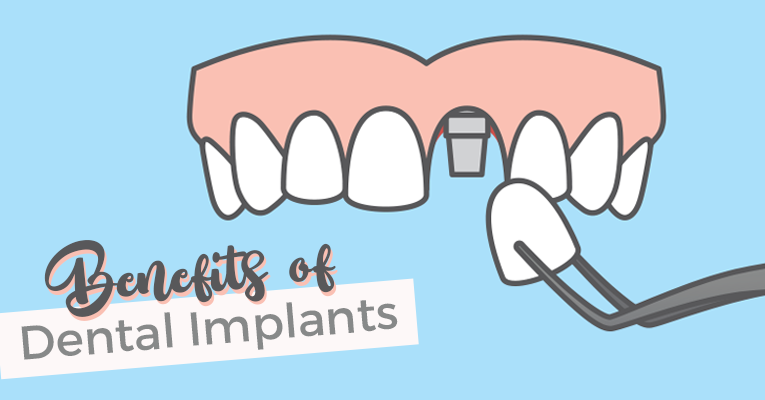
Missing teeth? You may be trying to decide what replacement procedure is best for you; dental implants, dentures or maybe even another option. When it comes to choosing, we always recommend dental implants. Dental Implants are a permanent solution to a lost tooth (or teeth) and have many benefits over some of your other options. To help make your decision a little bit easier, we’ve created a list of the top three benefits of dental implants!
1. Dental Implants Act Like Natural Teeth!
One of the most well-known benefits of dental implants is that they look and act just like your natural teeth. When properly placed, dental implants are nearly impossible to detect. Unlike dentures, which are removable and can cause discomfort to the wearer, dental implants are surgically placed into the jaw and provide no discomfort.
When dental implants are implanted to your jawbone, they provide the utmost of stability. This means that you can continue to eat your favorite foods, speak normally, and enjoy your improved self-esteem!
2. Improves Your Oral Health
Losing a tooth can have a big effect on the overall health of your mouth. When a tooth is lost, your gums begin to recede, which then causes the teeth to begin to shift, ultimately weakening your jaw bone which causes major problems for the rest of your remaining teeth. Dental implants provide stability to the jaw and prevent the surrounding teeth from shifting.
3. Reliability
Due to the permanent nature of dental implants, when properly taken care of, the implants can last a lifetime! Luckily, taking care of your implant is simple. Simply treat the implant as you would your other teeth, with the help of proper brushing and flossing.
Taking action to replace your missing tooth sooner rather than later will result in less headaches in the future. If you are considering dental implants as a dental procedure, give our office a call to schedule your consultation at Racine Office Phone Number 262-634-4646!