




Lakeside Oral Surgery & Implant Solutions
SHOULD WE GET CONE BEAM SCAN (CBS) IMAGES PRIOR TO THRID MOLAR REMOVAL?
Every once in awhile I read an article in a responsible medical or dental journal that just floors me in its stupidity. The article I reference here is one of these (JADA 148(8) 575-583). This article is nothing more than an analysis of other articles written on the subject which draws a completely stupid conclusion that “clinicians should not perform CT routinely before M3M surgery because using CT images does not seem to reduce incidence or affect the patient’s prognosis of IAN injuries in comparison with using PR images.”
First, panoramic imaging (PR images) has been and still is the standard of care for evaluation of impacted third molar teeth. Second, when we recommend the cone beam scan (CT) it is to evaluate someone who may be at a greater risk for complications such as nerve injury and the reason for that study is to better visualize impacted tooth position and the relative positioning of the adjacent vital structures. This is done in order to better prepare for the procedure and therefore reduce risks. Any experienced surgeon can tell you the surgical planning and risk reduction benefits of having better imaging. I have no question that having the pre-surgical information of the exact relationship of the impacted tooth roots to the relative vital structures such as the nerve reduces the risks to the patient of having resultant injuries to these structures.
I would trust your surgeon on this one. If they are suggesting that you get a cone beam scan prior to your third molar extractions do it. It is a minor study without a lot of radiation or cost and it can possibly be the difference between having a complication like a long term nerve injury or not.
IS ORAL HEALTH THE KEY TO OVERALL HEALTH?
Here is another article which seems to suggest that tooth loss predisposes one to the development of disease – rather than the opposite. Wow! Another crazy article in what should be our nation’s premiere dental journal – the JADA. This guest editorial suggests that maintaining good oral health is the key to reducing overall health problems (JADA 148(7) July 2017:477-480).
There is no question that maintaining good oral health, oral care, and oral hygiene are good for you, and an important part of your overall health care. But to suggest that getting it all correct with your mouth is going to reduce your rheumatoid arthritis or diabetes is very convoluted. The idea that patients with autoimmune disease such as rheumatoid arthritis tend to have poor oral care is more likely a reverse relationship. The autoimmune condition more likely predisposes one to having infective problems such as periodontitis or tooth decay. Similarly with the diabetic patient, a reduced immune status will contribute to dental disease. Because of this it is especially important for individuals with these concerns to get regular dental care.
We also must look at the social and environmental issues that may face individuals who are more prone to these conditions, especially nutrition deficiencies or balanced nutrition problems such as obesity and their contribution to a reduced immune status/connective tissue disease-conditions. Social issues such as access to care or proper home care would also be significant contributing factors. Although oral/dental disease can lead to systemic medical concerns; I feel the poor oral health issue is more commonly a symptom of other health/social factors rather than being the cause of them.
Dental Implants: Aftercare

Are you considering dental implants but are worried about the recovery time?
Don’t worry, we’re here to give you the facts!
The recovery time following dental implant surgery tends to vary but is usually based on the amount of teeth being implanted, whether or not a bone graft was needed and how well the individual manages his or her recovery. The science and technology behind dental implants have improved drastically over the last few years, improving post-surgery pain and comfort for patients.
Recovery Time
Typically, you will have the fastest recovery time if you had a standard, single dental implant placed with no bone grafting. With a simple procedure like this one, there is very little discomfort or pain after the surgery. Mild bruising and soreness can occur, but this can typically be managed with over the counter pain relievers. In more severe implant cases, such as those where multiple teeth are implanted or severe bone grafts are needed in order to accomplish the implant, the recovery time tends to be longer and the discomfort can be more intense.
Post-Op
It is important to keep your mouth clean after surgery, which can be done by rinsing your mouth gently with saltwater beginning the day after surgery. You may begin brushing your teeth the night after the surgery, but make sure to be extremely gentle around the surgery area as to not disrupt the healing process. Remember that in the week following your surgery, there should be no smoking and no sucking through a straw, as this can seriously inhibit your healing process. Stick to a diet primarily consisting of soft foods for the first 7-10 days following your surgery before beginning to return to your normal diet.
As you can see, the recovery process after receiving a dental implant is fairly predictable and comfortable. It is important to follow the instructions that we give you, and always remember that if you have any questions or concerns regarding a procedure or following your surgery, you can always give us a call.
WHY DO WOMEN SUFFER FROM TMJ PROBLEMS MORE THAN MEN?
The quick answer is that women, on average, have smaller anatomy than men and their smaller anatomy does not handle the stresses on the joint system placed by other variations in anatomy and physiology as well as it does for men. (2019 American Association of Oral and Maxillofacial Surgeons 0278-2391/19/30453-7) The most common main cause of TMD (temporomandibular dysfunction – a term used to group a wide variety of primarily muscular disorders of the jaw apparatus) is an imbalance in the way the jaws guide past each other in various movements such as side to side and front to back. This is primarily affected by abnormal tooth positons. The most typical of these is a jaw growth variation where the molar teeth are providing the guidance in the side to side jaw movements – what we call “balancing guidance.” The typical patient has a “reverse curve” to their bite. These problems can usually be addressed by orthodontic treatment alone, or in conjunction with jaw surgery (orthognathic surgery).
The truth is there are so many variables that come together from the joint anatomy, to the joint and capsule anatomy, to the jaw and facial anatomy, to the tissue receptors, to the chemistry of the joint structures, to psychological influences, to etc., etc. It is almost amazing that our jaw joints, in fact our bodies, function normally at all. Fortunately, our bodies have considerable ability to accommodate and compensate for abnormalities, injury, and disease processes.
When we consider internal joint diseases such as arthritis and autoimmune conditions we enter into another very wide realm of conditions and disorders that may have a significant effect on joint pain and joint problems. All of these things need to be fleshed out as we analyze joint conditions. On a very basic level my approach is to first make sure that the medical concerns are being dealt with and then deal with the physical problems addressing the obvious “big” problems first and keeping our eyes open to the other significant variables as we move forward.
If you have jaw joint problems discuss them with your dentist. Seek out consultations with a board certified orthodontist and oral surgeon. Get as much information as you can and watch out for “TMJ specialists.” Many of them do a good job, but there are way too many who are providing unnecessary therapies and treatment regimens without the likely chance of a solution.
VOLUNTEER PURSUITS
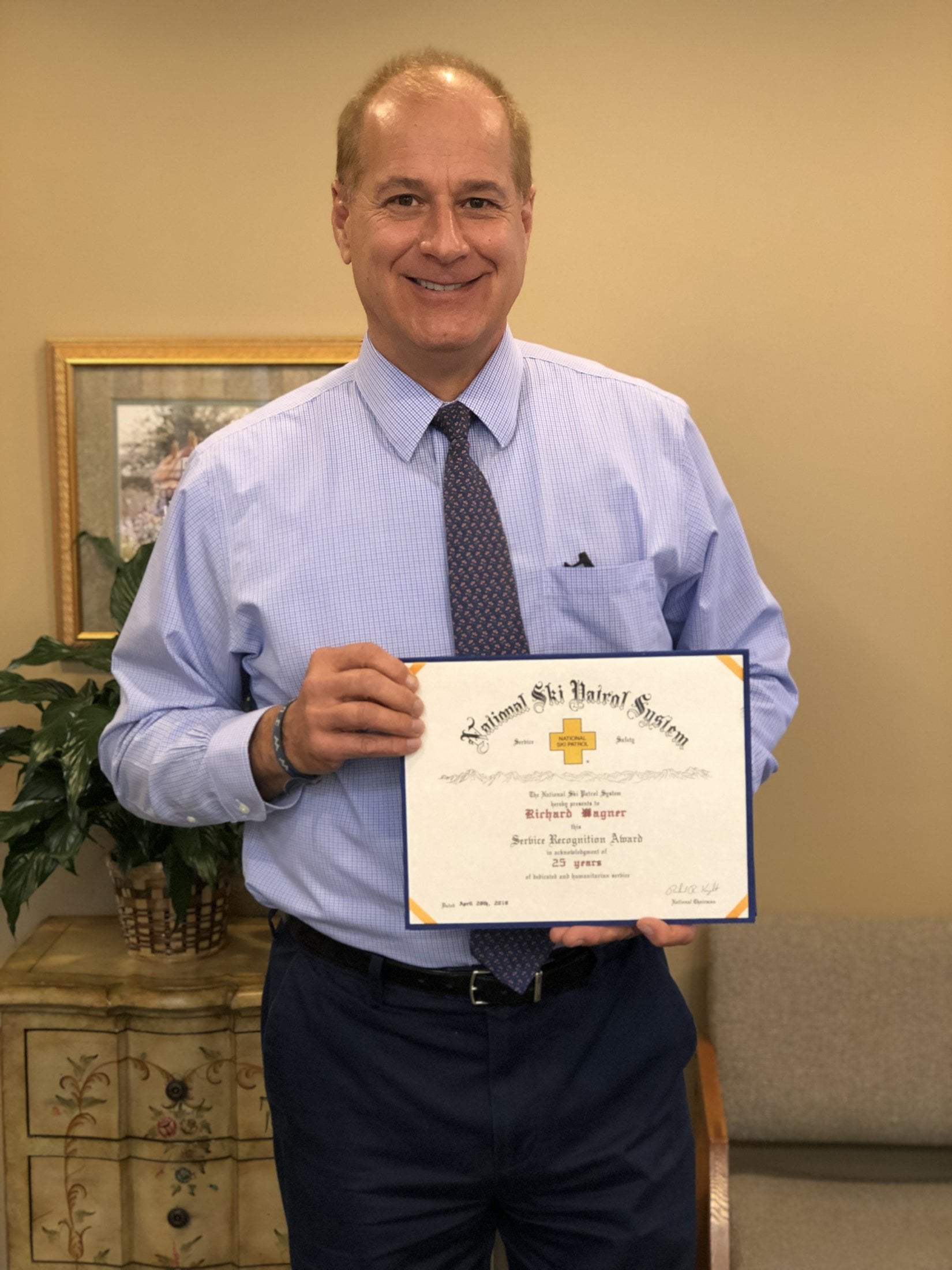 Dr. Richard M. Wagner is a member of the Alpine Valley Ski Patrol and has been a ski patroller for over 25 years. “Rich” is an Oral and Maxillofacial Surgeon in Racine and Kenosha Wisconsin and has served in a number of capacities with ski patrol including OEC and toboggan instructor.
You will find him patrolling the hills at Alpine Valley Ski Resort in Delavan on a typical Saturday afternoon and evening along with a great team of patrollers. Last year, as a group, they received the Outstanding Patrol Award given to the patrol team who exemplifies excellence in ski patrolling.
His friends call him “Rich” and he sums up his Ski Patrolling experience this way; “Ski Patrol has been a very important part of my life. I of course love the sport and I have been able to share it with my wife and our 4 children. My son John has been a Ski Patroller for over 10 years and being able to patrol along with him is a great joy for me.”
As it relates to volunteerism, Dr. Wagner is involved in a number of other activities and pursuits. For over 18 years he has been involved in international missions work. He, along with his family members and staff, have been all over the world working with a medical/dental team providing care for underserved third world areas. They typically go on 2 of these trips per year. In 2007 he received the Distinguished Alumni Award from UW Parkside for his work with international missions.
Locally, he participates in the annual Mission of Mercy with the Wisconsin Dental Association. This is a huge team involving hundreds of volunteers. They set up in various cities around the state providing free of charge dental care to underserved people. People come mainly from underserved communities, but they also get individuals traveling from surrounding states and regions to use this service. Locally, we participate in Give Kids a Smile Day and also in support of our community care clinic.
On a personal level, Dr. Wagner’s Christian faith is very important to him. He is involved in his church and church related activities. He serves as a leader in men’s ministry and music ministry.
History of Wisdom Teeth

Most people need their wisdom teeth removed, so why do we have them in the first place? Here’s a quick history lesson of wisdom teeth and the important role they once played!
Wisdom teeth were once an extremely valuable asset to our ancestors. When a typical diet consisted of chewy plants and uncooked meat, third molars (wisdom teeth), which fit easily into our ancestors’ larger jaws, were absolutely necessary. Wisdom teeth were the evolutionary answer to the need for chewing power to combat excessive wear.
Today, our diets are not as rough as those of our ancestors. With modern marvels like forks, spoons, and knives, as well as softer food, the need for wisdom teeth is virtually nonexistent. And yet, on average, about 65% of the human population is born with wisdom teeth which usually erupt between the ages 17 and 25.
Although wisdom teeth were incredibly advantageous for our ancestors, they pose a bit of a problem for the modern mouth. Humans have evolved to have smaller jaws, and so wisdom teeth are often either too big for the jaw or the jaws themselves are just too small. Either way, third molars crowd the mouth. Because of this lack of space, molars often grow sideways, only partially emerging from the gums, or actually get trapped inside the gums and jawbone.
These impacted wisdom teeth can be chronically contaminated with bacteria associated with infection, tooth decay, inflammation, and gum disease. And because they’re so far back in the mouth or trapped underneath gums, it’s difficult and sometimes impossible to keep them clean. Even when wisdom teeth come in fully, they are so far back in the mouth that it’s just too easy for food to get trapped, leading to plaque, cavities, and gum disease.
Although wisdom teeth were very important to our ancestors, nowadays, they pose a serious problem to oral health. Are you worried that your child may need wisdom teeth removal? Call our office at Racine Office Phone Number 262-634-4646 to find out more.
Oral Health: Get Your Oral Cancer Screening
Did you know that mouth cancer is the sixth most common cancer worldwide? The sad truth is that oral cancers are more than twice as common in men as in women, and the fastest growing group of oral cancer patients are young, healthy, nonsmoking individuals. Now is the time to be proactive and get yourself checked for oral cancer.
Remember—early detection saves lives! It is more important than ever for young adults, as well as older men and women, to get regular screenings whether they think they’re at risk or not.
What are the risks?
Knowing the risks can help you make educated decisions about your health. There are several risks that increase your chances of developing oral cancer:
• Smoking and using tobacco products are a known long-term historic cause of oral cancer.
• Heavy alcohol usage also makes you more susceptible to develop oral cancer.
• The HPV virus, a sexually-transmitted disease, is the leading cause of oropharyngeal (the back part of the mouth) cancer.
What are the signs and symptoms?
The mouth is one of the body’s most crucial early warning signs in the fight against oral cancer. In between regular dental visits, it’s important to be aware of the mouth’s signs and symptoms. Remember, if you see any of these signs or symptoms, schedule an appointment at the office if you don’t see improvement within two-three weeks:
• Hoarseness, chronic sore throat, or change in voice
• The development of white, red, or speckled (white and red) patches in the mouth
• Lumps, thickening tissues, rough spots, crusty or eroded areas
• Difficulty chewing or swallowing, speaking, or moving the jaw or tongue
• A change in the way your teeth or dentures fit together when you close your mouth
• Dramatic weight loss
• Unexplained numbness, loss of feeling, or pain/tenderness in any area of the face, mouth, or neck
• Unexplained bleeding in the mouth
Don’t wait any longer. Be proactive about your oral health, and get checked today!
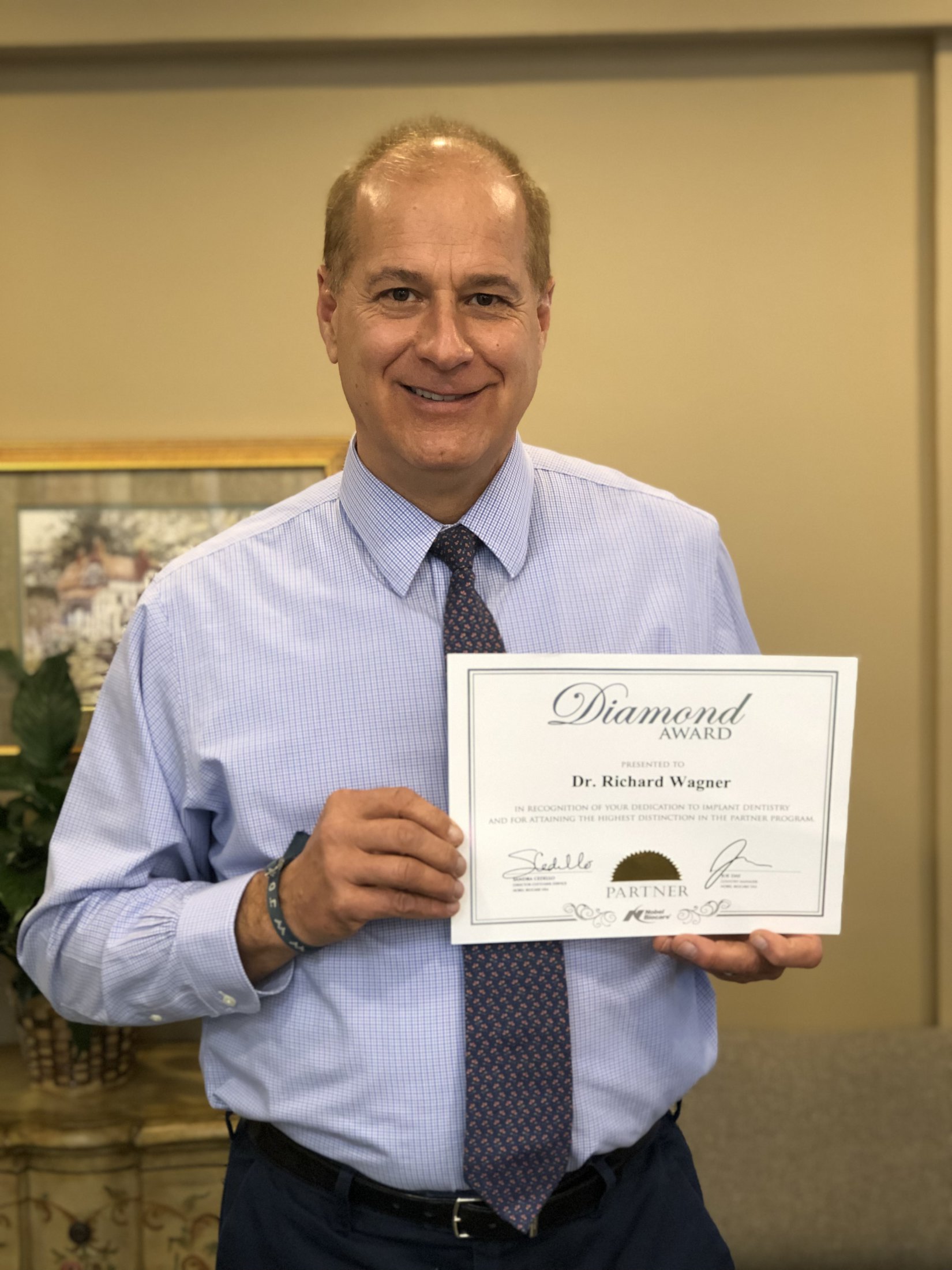
WAGNER RECEIVES NOBEL BIOCARE AWARD
Nobel Biocare created the Diamond Partner Status to recognize an elite group of doctors – those who are the most skilled and experienced in the art of dental implants. Dr. Wagner has exhibited a commitment to furthering the science and knowledge of dental implants. He actively promotes the advantages of dental implant care. His years of dedication to excellence in dental implant care and his continued commitment to that care is appreciated. This award is a small token of that appreciation.
How to Take Care of Your Dental Implant

Cleaning and taking care of your implant is just as important as cleaning your natural teeth. Here are some things you should know about caring for your implant.
Your implant and your natural teeth are similar because they both rely on healthy tissue for support! Just like with real teeth, plaque buildup can be harmful. It’s important to remove that plaque because it can develop into an infection. If the infection isn’t properly treated, it can result in a loss of bone around the implant which could progress to the loss of the implant itself.
It’s important to get your teeth cleaned on a regular basis so your dental hygienist can get biofilm off your teeth and keep your teeth infection-free. As always, you should be brushing your teeth and flossing twice a day.
Dental implants are the closest thing you can get to real and natural teeth. They don’t require any special products or treatment, just a simple brush and floss will do the job! If they are properly cared for, they can last a lifetime, avoiding any further dental work down the road.
With a dental implant, you can still enjoy all your favorite foods. It will not loosen or fall out if you are chewing something hard.
Overall, dental implants are meant to make life better and easier! You don’t have to go out of your way to take care of them – a simple brush and floss will ensure that they improve your overall quality of life for many years to come.
If you think a dental implant may be right for you, call Lakeside Oral Surgery & Implant Solutions at 262-634-4646 to schedule a consultation!
GENIOPLASTY-CHIN REDUCTION AND ADVANCEMENT
Over the years, I have used a number of different procedures for genioplasty procedures. I have watched my colleagues use various implant materials, but (I feel) luckily I have shied away from them. I have also avoided the use of metal bone screws and plates for these procedures as these have shown to cause long term problems.
My standard procedures are for bone sculpturing for reduction genioplasties and a sliding osteotomy with absorbable bone screws/plates (LactoSorb) for augmentation/advancement procedures. I prefer the use of either native bone or allogeneic bone if a graft is needed. Bone taken from the hip or tibia provides a wonderful graft, but the procedure to harvest the graft is way worse than the genioplasty. The results of genioplasty especially in combination with orthognathic surgery gives typically subtle yet cosmetically satisfying results.
Reference: (J Oral Maxillofac Surg 73:1583-1591, 2015)